

There’s a unique satisfaction that comes with crafting the perfect cup of coffee right in your own kitchen. For many, the aroma of freshly brewed coffee is the undisputed start to a productive day, a comforting ritual, or a delightful afternoon pick-me-up.
But with a dizzying array of gadgets and techniques available, how do you navigate the world of home brewing to find the best home coffee brewing methods that suit your taste and lifestyle?
Whether you’re a seasoned barista at heart or a curious newcomer, understanding the nuances of different brewing approaches can elevate your coffee experience from mundane to magnificent.
In 2025, more people than ever are seeking to replicate their favorite coffee shop drinks at home, driven by convenience, cost-efficiency, and the pure joy of creation.
This comprehensive guide will demystify the most popular and effective home coffee brewing methods, offering insights into each technique’s unique characteristics, required equipment, and the type of coffee it produces.
We’ll explore everything from the timeless elegance of a French press to the precise art of pour-over, ensuring you have all the information needed to choose your ideal brewing companion.
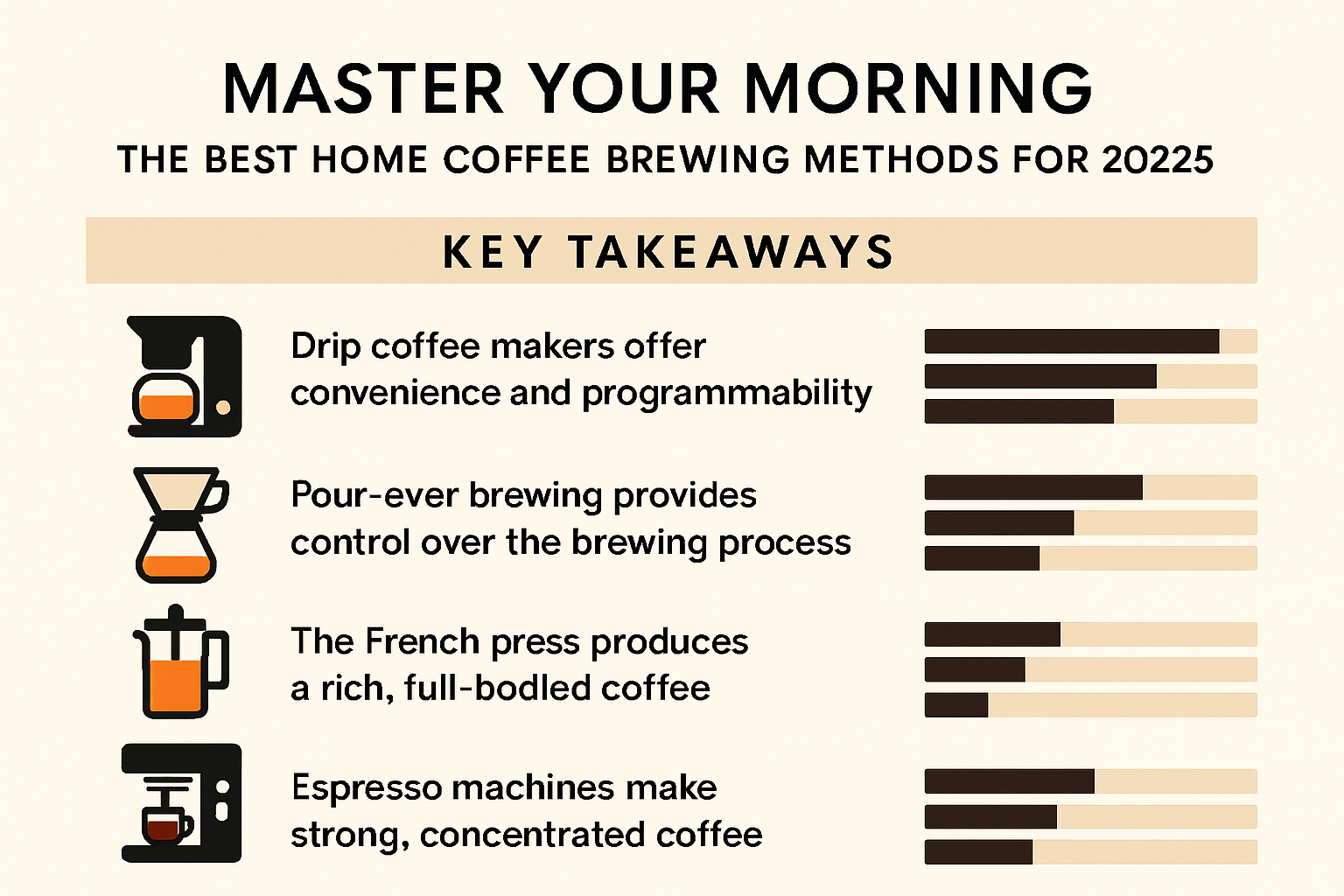
Key Takeaways
- Diverse Methods for Diverse Tastes: There isn’t one “best” method; the ideal choice depends on your desired flavor profile, time commitment, and budget.
- Quality Ingredients Matter: Regardless of the brewing method, fresh, quality whole beans and good water are paramount for an exceptional cup.
- Precision is Key: Tools like scales and timers can significantly improve consistency and extraction for many methods.
- Experimentation is Encouraged: Don’t be afraid to try different methods, grind sizes, and coffee-to-water ratios to discover your personal preference.
- Maintenance Extends Life: Regular cleaning of your brewing equipment ensures longevity and prevents off-flavors.
The Foundation of Great Coffee: Essential Equipment and Principles
Before diving into specific techniques, it’s crucial to acknowledge the universal truths that underpin all the best home coffee brewing methods. Think of these as the fundamental pillars supporting your quest for coffee perfection.
Quality Beans and Grinding
The journey to an exquisite cup begins with the beans. Opt for freshly roasted, whole bean coffee and grind it just before brewing. Pre-ground coffee loses its volatile aromatic compounds rapidly, leading to a duller flavor.
- Burr Grinder: This is a non-negotiable investment for serious home brewers. Unlike blade grinders that chop beans inconsistently, a burr grinder crushes them evenly, ensuring a consistent particle size crucial for proper extraction.
- Flat Burrs vs. Conical Burrs: Both produce excellent results, with minor differences in grind consistency and heat generation. For most home users, either will be a significant upgrade over blade grinders.
- Grind Size Matters:
- Coarse: French Press, Cold Brew
- Medium-Coarse: Chemex, Cafetiere
- Medium: Automatic Drip, Siphon
- Medium-Fine: Pour-Over (e.g., V60, Kalita Wave), Aeropress (longer brew time)
- Fine: Espresso, Moka Pot, Aeropress (shorter brew time)
- Extra Fine: Turkish Coffee
Water Quality and Temperature
Coffee is 98% water, so its quality directly impacts the final taste. Filtered water free from impurities and harsh minerals is ideal. As for temperature, the sweet spot for most brewing methods is between 195°F and 205°F (90°C and 96°C) [1]. Water that is too cool will under-extract, resulting in a sour, weak brew, while water that is too hot can over-extract, leading to bitterness. A gooseneck kettle, especially one with temperature control, offers precision that can drastically improve your results.
The Golden Ratio and Timing ⏳
The “golden ratio” for coffee brewing is often cited as 1:15 to 1:18 coffee-to-water (e.g., 1 gram of coffee for every 15-18 grams of water). This is a great starting point, but personal preference and specific brewing methods will dictate adjustments. A digital scale is indispensable for measuring both coffee and water accurately. Similarly, a timer helps control the contact time between coffee grounds and water, which is critical for preventing under or over-extraction.
“The true magic of coffee lies not just in the bean, but in the hands that meticulously prepare it, transforming simple ingredients into a daily ritual of delight.”
Delving into the Best Home Coffee Brewing Methods
Now, let’s explore the specific techniques that make up the landscape of home coffee brewing in 2025. Each method offers a unique journey and a distinct destination in your coffee cup.
1. The Art of Pour-Over: Precision and Purity
What it is: Pour-over brewing involves manually pouring hot water over coffee grounds in a filter, allowing gravity to slowly draw the brewed coffee into a carafe below. This method gives the brewer incredible control over the extraction process.
Why it’s one of the best home coffee brewing methods: Pour-over coffee is renowned for its clean, bright, and nuanced flavor profile. It highlights the subtle notes of the coffee bean, offering a more delicate and aromatic cup compared to immersion methods. The control over water flow, temperature, and saturation makes it a favorite among those who appreciate precision and clarity in their brew.
Required Equipment:
- Pour-Over Dripper: Hario V60, Kalita Wave, Chemex (a hybrid pour-over/immersion method) are popular choices. Each has a unique design that influences flow rate and extraction.
- Paper Filters: Specific to your dripper (e.g., V60 filters, Kalita Wave filters, Chemex bonded filters).
- Gooseneck Kettle: Essential for controlled, even water pouring.
- Burr Grinder: For a consistent medium-fine to medium grind.
- Digital Scale with Timer: For precise measurements of coffee and water, and to track brew time.
- Carafe or Mug: To collect the brewed coffee.
How to Brew (Hario V60 Example):
- Heat Water: Bring filtered water to 200-205°F (93-96°C).
- Grind Coffee: Grind your coffee to a medium-fine consistency. A good starting point is 20g of coffee for 300g of water.
- Prepare Dripper: Place a paper filter in your V60 dripper and rinse it thoroughly with hot water. This removes any papery taste and preheats the dripper. Discard the rinse water.
- Add Coffee: Pour your ground coffee into the filter and gently tap to level the bed. Place the dripper and carafe on your digital scale.
- Bloom: Start the timer. Pour just enough hot water (about twice the weight of your coffee, so 40g for 20g of coffee) evenly over the grounds to saturate them. Let it bloom for 30-45 seconds. This allows gases to escape, preparing the coffee for even extraction.
- Pour: Continue pouring the remaining water in slow, circular motions, working from the center outwards. Aim for a total brew time of 2:30-3:30 minutes. Ensure you don’t pour directly onto the filter paper.
- Enjoy: Once all the water has passed through, remove the dripper and savor your perfectly crafted pour-over.
Pro Tip: For consistency, consider logging your brew parameters. Small adjustments to grind size or pour speed can significantly alter the outcome. You might find a tool like this keyword research tool helps you track your coffee journey as diligently as it tracks keywords!
2. French Press: Robust Flavor and Full Body
What it is: The French press, also known as a cafetière, is an immersion brewing method where coarsely ground coffee is steeped in hot water, then separated from the liquid by pressing down a plunger with a mesh filter.
Why it’s one of the best home coffee brewing methods: If you love a full-bodied, rich, and robust cup of coffee with a satisfying mouthfeel, the French press is your go-to. Because the coffee grounds remain in contact with the water for the entire brewing period, and the mesh filter allows fine sediment and oils to pass through, the resulting brew is intensely flavorful and aromatic.
Required Equipment:
- French Press: Available in various sizes, typically glass or stainless steel.
- Burr Grinder: For a coarse, even grind.
- Kettle: Any standard kettle will do, but temperature-controlled is a bonus.
- Digital Scale and Timer: Recommended for consistency.
How to Brew:
- Heat Water: Heat filtered water to 200-205°F (93-96°C).
- Grind Coffee: Grind coffee coarsely, resembling sea salt. A common ratio is 1:12 to 1:15 (e.g., 30g coffee for 360g water).
- Preheat: Pour some hot water into the French press carafe, swirl, and discard to preheat it.
- Add Coffee: Add the coarse coffee grounds to the preheated French press.
- Add Water: Pour about half of your hot water over the grounds, ensuring they are fully saturated.
- Stir & Bloom: Gently stir the grounds to ensure even saturation. Let it bloom for about 30 seconds.
- Pour Remaining Water: Pour the rest of the hot water into the French press.
- Steep: Place the lid on top, with the plunger resting just above the water level (don’t press yet!). Let steep for 4 minutes.
- Plunge: After 4 minutes, slowly and steadily press the plunger all the way down.
- Serve Immediately: Pour the coffee into your mug right away to prevent further extraction and bitterness.
Anecdote: “I remember my first time using a French press. I’d always had drip coffee, and thought that was the peak. But the moment I plunged that filter and poured out that dark, rich liquid, the sheer depth of flavor was a revelation. It felt like I’d unlocked a secret level of coffee enjoyment in my own kitchen.”
3. Automatic Drip Coffee Maker: Convenience and Consistency
What it is: The automatic drip coffee maker is arguably the most common and straightforward home brewing method. Water is heated and then dripped over a bed of coffee grounds in a filter basket, collecting in a carafe below.
Why it’s one of the best home coffee brewing methods: For sheer convenience, ease of use, and consistent results with minimal effort, the automatic drip machine reigns supreme. Many models offer programmable features, allowing you to wake up to a freshly brewed pot. It’s an excellent option for brewing larger batches of coffee.
Required Equipment:
- Automatic Drip Coffee Maker: From basic models to high-end brewers. Look for SCAA (Specialty Coffee Association of America) certified brewers for optimal temperature and spray head design.
- Paper Filters: Cone or basket style, depending on your machine. Reusable permanent filters are also available.
- Burr Grinder: For a medium grind.
How to Brew:
- Add Water: Fill the water reservoir with fresh, filtered water.
- Add Coffee: Place a paper filter in the brew basket. Measure your coffee (a good starting point is 2 tablespoons of ground coffee for every 6 ounces of water) and add it to the filter. Grind to a medium consistency, like table salt.
- Brew: Turn on the machine and let it do its magic.
- Serve: Once the brewing cycle is complete, pour and enjoy.
Considerations for Automatic Drip:
- Temperature Stability: Cheaper machines often struggle to maintain the ideal brewing temperature, leading to less flavorful coffee.
- Shower Head Design: A good machine will have a shower head that evenly saturates the coffee grounds for optimal extraction.
- Heating Element: Some machines keep the coffee hot on a hot plate, which can lead to a burnt taste over time. Thermal carafes are preferred.
4. Moka Pot: Stovetop Espresso-Style Brew
What it is: The Moka pot, a classic Italian stovetop brewer, uses steam pressure to force hot water through ground coffee, producing a strong, concentrated brew often compared to espresso.
Why it’s one of the best home coffee brewing methods: For those who crave a bold, intense, and rich coffee reminiscent of espresso without the high cost and complexity of an espresso machine, the Moka pot is an excellent choice. It’s compact, durable, and produces a wonderfully strong base for lattes and cappuccinos.
Required Equipment:
- Moka Pot: Aluminum (classic) or stainless steel (more durable, compatible with induction).
- Burr Grinder: For a fine to medium-fine grind, slightly coarser than espresso.
- Stovetop: Gas, electric, or induction (if using a stainless steel Moka pot).
How to Brew:
- Heat Water: Fill the lower chamber with hot (not boiling) water up to the safety valve. Using hot water helps prevent the coffee from burning during the heating process.
- Add Coffee: Fill the filter basket with finely ground coffee, leveling it gently without tamping.
- Assemble: Screw the top and bottom chambers together tightly.
- Brew: Place the Moka pot on your stovetop over medium heat. Keep the lid open initially.
- Observe: As the water heats, pressure builds, and coffee will begin to trickle into the upper chamber. Once it starts to flow steadily, close the lid.
- Listen and Watch: When you hear a gurgling sound and see light-colored crema-like foam bubbling up, remove the Moka pot from the heat immediately to prevent burning.
- Serve: Pour and enjoy your strong, flavorful Moka pot coffee.
Tip: A Moka pot coffee is intensely concentrated. It can be enjoyed as is, diluted with hot water for an Americano-style drink, or used as a base for milk-based beverages.
5. AeroPress: Versatility and Portability
What it is: Invented in 2005, the AeroPress is a compact, portable device that uses air pressure to brew coffee, resulting in a smooth, clean, and often less acidic cup. It’s incredibly versatile, allowing for both immersion and press-style brewing.
Why it’s one of the best home coffee brewing methods: The AeroPress is celebrated for its speed, versatility, and ability to produce a consistently smooth cup with minimal bitterness. Its compact size makes it perfect for travel, camping, or small kitchens. It can brew a concentrated shot (like espresso) or a full-bodied coffee, and its small paper filters ensure a clean cup.
Required Equipment:
- AeroPress: The device itself comes with a plunger, chamber, filter cap, and stirring paddle.
- Paper Filters: Small, circular AeroPress filters.
- Burr Grinder: For a fine to medium-fine grind.
- Kettle: For hot water.
How to Brew (Standard Method):
- Heat Water: Heat water to 175-205°F (80-96°C), depending on your preferred strength and bean roast.
- Grind Coffee: Grind 14-17g of coffee to a fine-medium consistency.
- Prepare AeroPress: Place a paper filter in the filter cap and screw it onto the chamber. Place the chamber directly over your mug.
- Add Coffee: Add the ground coffee to the chamber.
- Add Water: Pour hot water into the chamber, stirring for 10 seconds.
- Press: Insert the plunger and press down slowly and steadily until you hear a hiss (about 20-30 seconds).
- Enjoy: You’ll have a concentrated shot. Dilute with hot water to your preferred strength, or add milk for a latte.
The Inverted Method: Many AeroPress enthusiasts prefer the “inverted method” to prevent premature dripping. You assemble the AeroPress upside down, add coffee and water, stir, and then carefully flip it onto your mug before pressing. This allows for longer immersion times.
Anecdote: “I once had an incredible AeroPress coffee brewed by a friend while backpacking in the mountains. The simplicity of the device, combined with the breathtaking scenery, made that humble cup of coffee feel like a gourmet experience. It truly highlighted how the AeroPress can deliver quality coffee anywhere.”
6. Cold Brew: Smoothness and Low Acidity
What it is: Cold brew is an immersion method where coarse coffee grounds are steeped in cold water for an extended period (12-24 hours) to extract flavor.
Why it’s one of the best home coffee brewing methods: Cold brew produces an incredibly smooth, low-acid, naturally sweet, and rich coffee concentrate. The lack of hot water means fewer bitter compounds are extracted, making it highly palatable, especially for those with sensitive stomachs. It’s perfect for making iced coffee and can be stored in the fridge for up to two weeks.
Required Equipment:
- Large Container: Pitcher, jar, or a dedicated cold brew maker.
- Fine Mesh Strainer or Cheesecloth: For initial straining.
- Paper Filters (Optional): For a cleaner secondary filtration.
- Burr Grinder: For a very coarse grind.
How to Brew:
- Grind Coffee: Grind your coffee to a very coarse consistency, similar to breadcrumbs. A ratio of 1:8 to 1:5 coffee-to-water (by weight) is common for a concentrate.
- Combine: Add the coarse coffee grounds to your container. Pour cold, filtered water over the grounds, ensuring they are fully saturated. Stir gently.
- Steep: Cover the container and let it steep at room temperature or in the refrigerator for 12-24 hours. Longer steeping times yield a stronger concentrate.
- Strain: After steeping, strain the concentrate through a fine mesh strainer lined with cheesecloth to remove the bulk of the grounds. For an even cleaner result, strain again through a paper coffee filter (though this can be slow).
- Store and Serve: Store the cold brew concentrate in an airtight container in the refrigerator. To serve, dilute the concentrate with water, milk, or ice to your desired strength.
Choosing Your Best Home Coffee Brewing Method
With so many excellent options, how do you decide which of the best home coffee brewing methods is right for you in 2025? Consider these factors:
Flavor Preference
- Clean, bright, delicate: Pour-Over (V60, Chemex)
- Robust, full-bodied, rich: French Press, Moka Pot
- Smooth, low-acid, sweet: Cold Brew, AeroPress
- Balanced, consistent: Automatic Drip
Time Commitment
- Quick & Easy (minimal effort): Automatic Drip, AeroPress (fast brew)
- Moderate (hands-on, but rewarding): Pour-Over, French Press, Moka Pot
- Longer Prep (hands-off, but overnight): Cold Brew
Budget
- Entry-Level (low cost): French Press, AeroPress, basic Automatic Drip, Moka Pot
- Mid-Range: Higher-end Pour-Over setups, SCAA-certified Automatic Drip machines
- Higher Investment: Espresso machines (not covered in detail here but a significant step up in cost and complexity)
Lifestyle and Portability
- For travel/camping: AeroPress
- For entertaining/large batches: Automatic Drip, larger French Press
- For daily ritual/precision: Pour-Over
- For strong morning kick: Moka Pot
Helpful Comparison Chart:
| Method | Flavor Profile | Ease of Use | Brew Time | Cost of Equipment (Starter) | Portability | Ideal For |
|---|---|---|---|---|---|---|
| Pour-Over | Clean, Bright, Nuanced | Moderate | 3-5 min | $$ | Low | Highlighting bean origin, refined tastes, morning ritual |
| French Press | Rich, Full-Bodied, Robust | Easy | 4-5 min | $ | Moderate | Bold coffee lovers, easy entertaining, strong morning cup |
| Automatic Drip | Balanced, Consistent | Very Easy | 5-10 min | $-$$ | Low | Convenience, batch brewing, quick weekday mornings |
| Moka Pot | Strong, Intense, Espresso-like | Moderate | 5-8 min | $ | High | Stovetop espresso alternative, milk-based drinks, strong coffee |
| AeroPress | Smooth, Clean, Versatile | Easy | 1-2 min | $ | Very High | Travel, quick brews, smooth espresso-like shots, versatility |
| Cold Brew | Smooth, Low-Acid, Sweet | Easy (hands-off) | 12-24 hrs (steep) | $ | High | Iced coffee, sensitive stomachs, make-ahead convenience |
(Cost of Equipment: $ = Under $30, $$ = $30-$100, $$$ = Over $100 for basic setup)
As you consider your options, remember that the best home coffee brewing methods are those that consistently deliver a cup of coffee you genuinely enjoy. Sometimes, the simplest method is the best. Other times, the journey of mastering a more complex technique is part of the joy. To help manage all these considerations, think about how you approach other choices, such as selecting the Top 5 Best Keurig Coffee Makers Insider Reviews Prices similar decision-making processes apply.
Elevating Your Coffee Experience in 2025: Beyond the Brew
Beyond the brewing method itself, several practices can further enhance your daily coffee ritual:
Freshness is Foremost
- Buy Whole Beans: Always buy whole beans. Once ground, coffee starts losing its flavor rapidly.
- Store Properly: Keep beans in an airtight container, away from light, heat, and moisture. Avoid the refrigerator; it introduces condensation and odors.
- Check Roast Date: Look for beans roasted within the last 2-3 weeks for optimal flavor.
Experiment with Coffee Varieties
Different origins, roasts, and processing methods yield distinct flavor profiles. Don’t be afraid to explore:
- Light Roasts: Often highlight fruity, floral, or acidic notes.
- Medium Roasts: Balanced, with notes of chocolate, nuts, or caramel.
- Dark Roasts: Bold, smoky, often with bitter undertones.
Cleaning and Maintenance
Regular cleaning of your brewing equipment is crucial. Coffee oils can build up, leading to stale and bitter flavors.
- Rinse After Every Use: Especially with French presses and Moka pots.
- Deep Clean Periodically: Descale automatic drip machines, and thoroughly clean all components of other brewers.
Mindfulness in Brewing
Take a moment to appreciate the process. The smell of freshly ground beans, the sound of water heating, the steam rising from your finished cup—these are all part of the sensory experience that makes coffee more than just a drink. This mindful approach can be just as fulfilling as the outcome, much like the careful planning that goes into finding Brewing Elixir: A Step-by-Step Coffee Maker Guide.
Conclusion: Your Journey to the Perfect Cup
The world of coffee brewing is vast and rewarding, offering endless opportunities for discovery and enjoyment. In 2025, with so many innovative tools and techniques readily available, there has never been a better time to refine your home brewing skills. From the intricate dance of a pour-over to the comforting simplicity of a French press, the best home coffee brewing methods are those that resonate with your personal taste and lifestyle.
The key is to start with quality ingredients – fresh, whole beans and good water – and then experiment. Don’t be intimidated by the array of options. Begin with a method that appeals to you, master it, and then perhaps branch out. Remember, brewing coffee at home is not just about making a drink; it’s about engaging in a ritual, enjoying a moment of calm, and creating a personalized experience that truly satisfies.
Actionable Next Steps:
- Assess Your Preferences: Think about the kind of coffee you genuinely enjoy (bold, delicate, smooth, strong).
- Evaluate Your Lifestyle: How much time are you willing to dedicate to brewing each day? Do you need portability?
- Choose a Method to Try: Based on the information above, select one or two of the best home coffee brewing methods that align with your preferences and budget.
- Invest in Key Equipment: Prioritize a good burr grinder and fresh, quality beans.
- Start Brewing and Experimenting: Don’t be afraid to adjust grind size, water temperature, and coffee-to-water ratios. Keep a small journal to track your results.
- Explore Further: Once comfortable, consider exploring different coffee origins, roasts, or even other brewing methods. The journey to the perfect cup is an ongoing adventure!
The pursuit of the perfect cup is a delightful journey, and 2025 is the perfect year to embark on it. Happy brewing!
References
[1] Specialty Coffee Association (SCA) Brewing Standards. (n.d.). Retrieved from https://sca.coffee/
Discover more from 101 Amazing Coffee
Subscribe to get the latest posts sent to your email.

