

The culinary world is vibrant and dynamic, but behind every successful restaurant lies meticulous financial management. Understanding and controlling restaurant operating expenses is not merely an accounting task; it’s the bedrock of sustained profitability and long-term success.
In an industry notoriously famous for its thin margins, every dollar spent and saved directly impacts the bottom line. From the cost of ingredients to the wages of your dedicated staff, from the monthly rent to the marketing budget, these expenses dictate whether a restaurant thrives or merely survives.
For restaurateurs navigating the complex landscape of 2025, a deep dive into these expenditures is essential, providing the clarity needed to make informed decisions, optimize operations, and cultivate a robust financial future.
This comprehensive guide will break down the various facets of restaurant operating expenses / occupancy costs , offering actionable insights and strategies to manage them effectively.
Whether you’re a seasoned owner or a budding entrepreneur, mastering these financial levers is your key to unlocking greater efficiency and securing a competitive edge in the bustling restaurant market.
Key Takeaways
- Prime Costs are Paramount: Food and labor constitute the largest portion of restaurant operating expenses. Effective management of these two areas is critical for profitability.
- Beyond the Plate and Paycheck: Don’t overlook occupancy costs, utilities, marketing, and administrative expenses. These overheads significantly impact your financial health.
- Data-Driven Decisions: Utilizing technology and financial analysis tools is crucial for tracking, categorizing, and optimizing expenditures in 2025.
- Strategic Cost Control: Implement proactive strategies such as inventory management, staff scheduling optimization, and energy efficiency to reduce costs without compromising quality.
- Continuous Monitoring is Key: Regular review of financial statements and key performance indicators (KPIs) is essential to identify trends, address inefficiencies, and ensure long-term sustainability.
Understanding the Landscape of Restaurant Operating Expenses
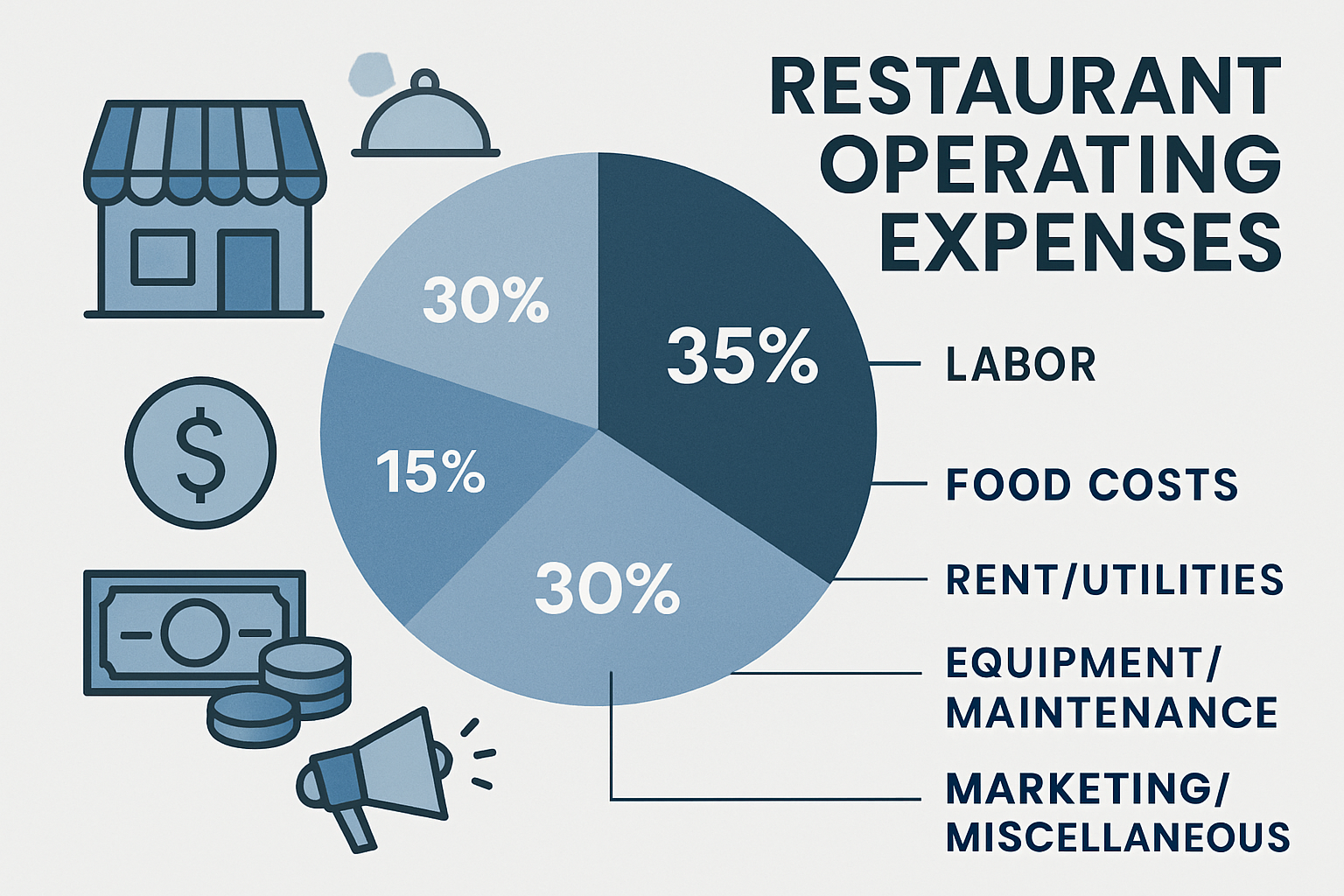
Running a restaurant involves a multitude of costs, far beyond simply buying ingredients and paying staff. These restaurant operating expenses can be broadly categorized, but their specific impact varies greatly depending on the restaurant’s concept, location, size, and operational model. A clear understanding of each category is the first step toward effective financial management.
Prime Costs: The Core of Restaurant Expenses
Prime costs are the most significant expenses a restaurant faces, typically accounting for 60-70% of total operating costs [1]. They are direct costs associated with producing and serving food and beverages.
Food and Beverage Costs
This category includes everything purchased to create menu items and drinks. It’s often expressed as a “food cost percentage” or “beverage cost percentage,” calculated by dividing the cost of goods sold (COGS) by revenue.
- Raw Ingredients: Meats, produce, dairy, grains, spices, etc.
- Prepared Goods: Sauces, baked goods, pre-cut vegetables from suppliers.
- Beverages: Alcoholic and non-alcoholic drinks, coffee, tea.
- Packaging: Takeout containers, delivery bags, napkins, straws.
- Waste and Spoilage: Losses due to expired products, incorrect orders, or accidental damage.
“Effective inventory management and strategic menu engineering are indispensable for controlling food and beverage costs.”
Labor Costs
Labor costs encompass all expenses related to employing staff, from the front-of-house to the back-of-house. This is often the second-largest expense.
- Wages and Salaries: Hourly pay for servers, cooks, dishwashers, hosts, and fixed salaries for managers, chefs.
- Payroll Taxes: Employer contributions for Social Security, Medicare, unemployment insurance.
- Employee Benefits: Health insurance, paid time off, retirement contributions.
- Overtime Pay: Additional compensation for hours worked beyond standard limits.
- Training and Development: Costs associated with onboarding new staff and ongoing skill development.
Table 1: Typical Prime Cost Breakdown (Percentage of Revenue)
| Expense Category | Typical Range (%) |
|---|---|
| Food & Beverage Cost | 25-35% |
| Labor Cost | 25-35% |
| Total Prime Cost | 50-70% |
Occupancy Costs: Your Restaurant’s Address
These are the expenses associated with the physical location of your restaurant.
- Rent/Lease Payments: Monthly payments for the commercial space.
- Property Taxes: Taxes levied on the real estate.
- Property Insurance: Coverage against damage, liability, and business interruption.
- Common Area Maintenance (CAM) Fees: Costs for maintaining shared spaces in a multi-tenant building.
- Depreciation: The expense of assets like buildings or major renovations over their useful life.
Utilities: Keeping the Lights On and the Kitchen Running
Essential for daily operations, utilities can fluctuate based on usage and seasonality.
- Electricity: Power for lighting, kitchen equipment, HVAC.
- Gas: For cooking, heating, water heaters.
- Water and Sewer: For kitchen operations, restrooms, cleaning.
- Waste Removal: Garbage collection and recycling services.
Operating Overhead: Beyond Prime and Occupancy
This broad category covers all other necessary expenses that keep the business running.
- Marketing & Advertising: Promotions, social media campaigns, print ads, website maintenance.
- Administrative & General: Office supplies, POS system fees, accounting software, legal fees, bank charges.
- Repairs & Maintenance: Routine upkeep of equipment, premises, and unexpected fixes.
- Supplies: Cleaning supplies, uniforms, smallwares (dishes, cutlery) replacements.
- Licensing & Permits: Annual fees for health permits, liquor licenses, business licenses.
- Technology: Internet service, phone lines, software subscriptions, security systems.
- Insurance (Other): General liability, workers’ compensation (separate from payroll tax contributions), equipment insurance.
By meticulously tracking and analyzing these diverse categories, restaurateurs can gain a comprehensive picture of their financial health and identify areas for potential optimization.
Strategic Management of Restaurant Operating Expenses
Managing restaurant operating expenses effectively requires more than just tracking; it demands strategic planning, continuous monitoring, and proactive adjustments. For 2025, embracing data-driven decision-making and efficient operational practices is paramount.
Optimizing Prime Costs: The Biggest Impact
Since food and labor costs represent the lion’s share of expenses, even small improvements here can yield significant savings.
Food Cost Control Strategies
- Menu Engineering: Analyze menu item profitability and popularity. Remove underperforming items, adjust portion sizes, and focus on high-margin dishes.
- Supplier Management: Negotiate better prices with suppliers, explore alternative vendors, and ensure consistent quality. Consider bulk purchasing for non-perishable items.
- Inventory Management: Implement a robust inventory system (e.g., FIFO – First-In, First-Out). Conduct regular inventory counts to minimize waste, prevent theft, and track usage.
- Waste Reduction: Train staff on proper food handling, preparation, and portion control. Repurpose ingredients where possible and track spoilage closely.
- Standardized Recipes: Ensure consistent quality and portion sizes, reducing variability and waste.
Labor Cost Control Strategies
- Smart Scheduling: Utilize POS data and sales forecasts to create efficient schedules, ensuring adequate staffing during peak hours without overstaffing during slow periods.
- Cross-Training Staff: Empower employees to work multiple roles, increasing flexibility and reducing the need for additional hires during absences or busy shifts.
- Performance Incentives: Motivate staff with incentives for efficiency, sales, or customer satisfaction, leading to better productivity.
- Technology for Efficiency: Implement online scheduling software, automated time clocks, and communication tools to streamline HR processes and reduce administrative overhead.
- Employee Retention: High turnover is costly. Invest in a positive work environment, competitive wages, and training to reduce recruitment and onboarding expenses.
Taming Occupancy and Utility Costs
While often fixed, there are still ways to mitigate these essential restaurant operating expenses.
Occupancy Cost Management
- Lease Negotiation: When renewing a lease, negotiate favorable terms, including rent increases, maintenance responsibilities, and options for expansion.
- Space Utilization: Maximize the use of your existing space to generate more revenue per square foot.
- Energy-Efficient Upgrades: Invest in LED lighting, energy-efficient appliances, and smart thermostats to reduce utility bills.
- Regular Maintenance: Proactive maintenance of HVAC systems and kitchen equipment can prevent costly breakdowns and improve efficiency.
Utility Cost Reduction
- Energy Audits: Schedule professional energy audits to identify areas of significant energy waste and implement targeted solutions.
- Smart Technology: Install smart sensors for lighting and climate control that adjust automatically based on occupancy and time of day.
- Water Conservation: Implement low-flow fixtures, train staff on water-saving practices, and promptly fix leaks.
- Equipment Maintenance: Regularly clean and maintain refrigeration units, ovens, and other equipment to ensure they operate at peak efficiency.
Controlling Overhead: Attention to Detail
The myriad of smaller restaurant operating expenses can add up quickly if not managed proactively.
Marketing and Administrative Cost Optimization
- Targeted Marketing: Focus your marketing efforts on channels that provide the best return on investment (ROI). Utilize social media and email marketing, which can be cost-effective.
- Negotiate Service Contracts: Periodically review and negotiate contracts for waste removal, pest control, security, and cleaning services.
- Cloud-Based Solutions: Adopt cloud-based accounting, HR, and POS systems to reduce hardware costs and improve accessibility.
- Bulk Purchasing: Buy office supplies, cleaning products, and uniforms in bulk when feasible to benefit from volume discounts.
Repairs and Maintenance
- Preventative Maintenance: Establish a schedule for regular maintenance of all kitchen equipment, HVAC systems, and plumbing. This prevents costly emergency repairs and extends the lifespan of assets.
- Qualified Technicians: Use certified and reputable technicians for specialized repairs to ensure quality work and prevent recurring issues.
- DIY Minor Fixes: Train staff on how to handle minor issues (e.g., resetting circuit breakers, changing lightbulbs) to avoid calling external services for simple tasks.
The Role of Technology in Managing Restaurant Operating Expenses
In 2025, technology is no longer a luxury but a necessity for efficient restaurant operations and effective management of restaurant operating expenses. Modern solutions provide invaluable data, automate tedious tasks, and offer insights that were once out of reach.
Point-of-Sale (POS) Systems
A robust POS system is the central nervous system of a restaurant.
- Sales Tracking: Provides real-time data on sales by item, server, time of day, and payment method. This data is critical for accurate forecasting and menu engineering.
- Inventory Integration: Many modern POS systems integrate with inventory management software, automatically deducting ingredients from stock as dishes are sold.
- Labor Tracking: Tracks employee clock-ins/outs, breaks, and tips, streamlining payroll processing and helping to monitor labor costs in real-time.
- Reporting and Analytics: Generates detailed reports on various aspects of restaurant performance, aiding in identifying trends and cost-saving opportunities.
Inventory Management Software
Dedicated inventory software is crucial for controlling food and beverage costs.
- Recipe Costing: Accurately calculates the cost of each menu item, helping to set profitable prices and identify high-cost ingredients.
- Automated Ordering: Can generate purchase orders based on par levels and historical sales data, reducing over-ordering and waste.
- Waste Tracking: Records spoilage, breakage, and theft, providing a clear picture of inventory losses.
- Supplier Integration: Connects with suppliers for streamlined ordering and price comparison.
Labor Management and Scheduling Software
These tools directly impact labor costs, a major component of restaurant operating expenses.
- Demand Forecasting: Uses historical sales data to predict staffing needs accurately, preventing overstaffing during slow periods and understaffing during rushes.
- Automated Scheduling: Creates schedules that comply with labor laws and employee availability, minimizing overtime.
- Time and Attendance: Digital time clocks and biometric systems ensure accurate payroll and prevent “buddy punching.”
- Communication: Facilitates easy communication between managers and staff regarding shifts, availability, and announcements.
Accounting and Financial Management Software
Essential for overall financial health and understanding restaurant operating expenses.
- Expense Tracking: Categorizes all expenses, making it easy to see where money is being spent.
- Automated Bookkeeping: Integrates with POS and bank accounts to automate data entry and reconciliation.
- Financial Reporting: Generates profit and loss statements, balance sheets, and cash flow reports, providing a clear financial overview.
- Budgeting Tools: Helps create and track budgets, comparing actual spending against planned expenditures.
“Embracing modern restaurant technology transforms raw data into actionable insights, providing a competitive edge in managing operating expenses.”
Energy Management Systems
With rising utility costs, these systems are becoming increasingly valuable.
- Smart Thermostats: Automatically adjust temperatures based on occupancy, time of day, and external weather conditions.
- LED Lighting: Reduces electricity consumption and maintenance costs.
- Appliance Monitoring: Tracks energy usage of major kitchen equipment, identifying inefficient units.
- HVAC Optimization: Ensures heating, ventilation, and air conditioning systems run optimally, reducing energy waste.
By leveraging these technological advancements, restaurateurs can gain unprecedented control over their restaurant operating expenses, leading to enhanced efficiency, reduced waste, and ultimately, greater profitability.
Key Performance Indicators (KPIs) for Monitoring Restaurant Operating Expenses
To effectively manage restaurant operating expenses, it’s crucial to consistently monitor key performance indicators (KPIs). These metrics provide a snapshot of financial health and highlight areas that require attention. Regular review of these KPIs allows restaurateurs to make timely adjustments and ensure their business stays on track for profitability in 2025.
Prime Cost Percentage
This is arguably the most critical KPI. It combines food and labor costs relative to revenue.
- Formula: (Cost of Goods Sold + Labor Costs) / Total Revenue
- Importance: A high prime cost percentage indicates inefficiencies in ingredient purchasing, menu pricing, portion control, or staffing levels. Industry benchmarks typically aim for 50-60%.
- Actionable Insight: If prime costs are rising, investigate food waste, supplier pricing, employee schedules, or potential theft.
Food Cost Percentage (FCP)
Focuses specifically on the cost of ingredients and beverages.
- Formula: Cost of Goods Sold (Food & Beverage) / Food & Beverage Revenue
- Importance: Helps assess the efficiency of purchasing, inventory management, and menu pricing.
- Actionable Insight: Analyze individual dish costs, compare supplier prices, reduce waste, and ensure menu prices reflect current ingredient costs.
Labor Cost Percentage (LCP)
Measures the proportion of revenue spent on staffing.
- Formula: Total Labor Costs / Total Revenue
- Importance: Reveals how efficiently staff are scheduled and managed. Includes wages, benefits, and payroll taxes.
- Actionable Insight: Review staffing levels during peak vs. off-peak hours, cross-train staff, and consider productivity improvements.
Break-Even Point
The point at which total costs and total revenues are equal, meaning there is no net loss or gain.
- Formula: Total Fixed Costs / ((Total Sales – Total Variable Costs) / Total Sales)
- Importance: Knowing your break-even point helps you understand the minimum sales volume needed to cover all restaurant operating expenses.
- Actionable Insight: If your current sales are too close to or below your break-even point, you need to either increase sales or reduce fixed/variable costs.
Occupancy Cost Percentage
Measures how much of your revenue goes towards rent, property taxes, and insurance for your physical space.
- Formula: Total Occupancy Costs / Total Revenue
- Importance: Provides insight into the financial burden of your location. Typically, this should be below 6-10% of revenue [2].
- Actionable Insight: If this percentage is too high, it might indicate that your location is too expensive for your current revenue, or you need to boost sales significantly.
Inventory Turnover Ratio
Indicates how many times inventory is sold and replaced over a period.
- Formula: Cost of Goods Sold / Average Inventory
- Importance: A higher turnover ratio generally means less capital tied up in inventory and reduced risk of spoilage.
- Actionable Insight: A low turnover might suggest over-ordering or slow-moving items. Aim for a turnover that balances fresh ingredients with bulk purchasing benefits.
Net Profit Margin
The ultimate measure of a restaurant’s profitability, after all expenses have been deducted from revenue.
- Formula: Net Profit / Total Revenue
- Importance: This KPI shows the percentage of revenue that turns into actual profit.
- Actionable Insight: If the net profit margin is low, a comprehensive review of all restaurant operating expenses and revenue-generating strategies is necessary.
By consistently tracking and analyzing these KPIs, restaurateurs can gain a holistic view of their financial performance, identify areas of concern, and implement targeted strategies to optimize their restaurant operating expenses and drive sustained profitability.
Conducting a Comprehensive Cost Analysis for Restaurant Operating Expenses
A regular, in-depth cost analysis is a powerful tool for understanding where money is truly going within your restaurant. It goes beyond simply tracking expenses; it’s about dissecting data, identifying trends, and uncovering opportunities for efficiency improvements and cost reduction. For 2025, a proactive approach to cost analysis is non-negotiable for competitive restaurants.
Step 1: Gather All Financial Data
Before you can analyze, you need a complete picture.
- Collect Expense Reports: Compile all invoices, receipts, payroll records, bank statements, and utility bills for a specific period (e.g., monthly, quarterly).
- Review POS Data: Extract sales reports, labor reports, and any integrated inventory data from your POS system.
- Access Accounting Software: Utilize your accounting platform for comprehensive profit and loss statements, balance sheets, and cash flow reports.
Step 2: Categorize and Classify Expenses
Organize your collected data into meaningful categories. This is where the initial breakdown of prime costs, occupancy costs, and operating overhead becomes critical.
- Variable Costs: Expenses that change with the volume of business (e.g., food costs, hourly labor, some utility usage).
- Fixed Costs: Expenses that remain relatively constant regardless of sales volume (e.g., rent, salaries for management, insurance premiums).
- Semi-Variable Costs: Costs with both a fixed and a variable component (e.g., utilities with a base charge plus usage, internet with a fixed plan and data overage fees).
Pull Quote: “A clear understanding of variable vs. fixed costs is fundamental to effective budgeting and strategic decision-making regarding restaurant operating expenses.”
Step 3: Calculate Key Performance Indicators (KPIs)
As discussed in the previous section, calculating KPIs for the analyzed period is essential for benchmarking and identifying performance.
- Prime Cost Percentage: The most important one to calculate first.
- Food Cost Percentage: Break down further by category (e.g., meat, produce) if possible.
- Labor Cost Percentage: Differentiate between front-of-house and back-of-house if your data allows.
- Occupancy Cost Percentage: Understand the real estate burden.
- Net Profit Margin: The ultimate indicator of overall financial health.
Step 4: Analyze Trends and Variances
Compare your current data against historical performance, budget forecasts, and industry benchmarks.
- Historical Comparison: Are costs increasing or decreasing compared to last month, last quarter, or the same period last year? Why?
- Budget vs. Actual: How do your actual expenses compare to your budgeted amounts? Significant variances (positive or negative) require investigation.
- Industry Benchmarks: How do your percentages (e.g., food cost, labor cost) stack up against similar restaurants in your market?
- Identify Anomalies: Look for unusual spikes or drops in specific expense categories. Was there a large repair bill? A sudden increase in ingredient prices?
Step 5: Pinpoint Areas for Improvement
Based on your analysis, identify specific opportunities to reduce or optimize restaurant operating expenses.
- High-Cost Items: Which ingredients are contributing most to your food cost? Can you find alternative suppliers or adjust menu pricing?
- Labor Inefficiencies: Are there periods of overstaffing? Can shifts be optimized or staff cross-trained?
- Waste Points: Is there excessive spoilage, breakage, or portioning issues?
- Underperforming Services: Are you paying for marketing channels or software subscriptions that aren’t delivering value?
- Negotiation Opportunities: Are there contracts (suppliers, utilities, services) that could be renegotiated?
Step 6: Implement Corrective Actions and Monitor Results
Analysis without action is futile. Develop an action plan and put it into motion.
- Set Goals: Establish clear, measurable goals for cost reduction in identified areas (e.g., “Reduce food waste by 10% next quarter”).
- Assign Responsibilities: Delegate tasks to specific team members.
- Implement Changes: Introduce new inventory procedures, revise schedules, explore new suppliers, or invest in energy-saving equipment.
- Continuous Monitoring: Re-evaluate your KPIs regularly after implementing changes to ensure they are having the desired effect. This iterative process of analysis, action, and monitoring is crucial for long-term financial health.
By undertaking this systematic approach to cost analysis, restaurateurs can transform their understanding of restaurant operating expenses from a daunting task into a strategic advantage, paving the way for greater control and profitability in 2025.
Conclusion
Navigating the intricate world of restaurant operating expenses is a defining challenge for any culinary business. From the bustling energy of the kitchen to the welcoming atmosphere of the dining room, every aspect of a restaurant’s operation carries a financial implication. As we move through 2025, the ability to meticulously track, analyze, and strategically manage these expenditures will differentiate thriving establishments from those that struggle.
This article has provided a comprehensive overview of the various categories of restaurant operating expenses, from the significant prime costs (food and labor) to essential occupancy costs and diverse operating overheads. It has highlighted the critical role of technology in modern expense management, offering tools that transform raw data into actionable insights. Furthermore, the importance of key performance indicators (KPIs) for continuous monitoring and the systematic approach of a detailed cost analysis have been emphasized as indispensable practices for sustainable growth.
Mastering restaurant operating expenses is not a one-time fix but an ongoing commitment to financial vigilance and operational excellence. By adopting a proactive, data-driven approach, restaurateurs can identify inefficiencies, implement targeted solutions, and optimize every dollar spent. This dedication to financial health ensures not only the survival but the flourishing of culinary ventures in a competitive market.
Actionable Next Steps:
- Conduct a Current Expense Audit: Start by gathering all your financial records from the last quarter and categorize every expense. Use the categories outlined in this article as a guide.
- Calculate Your Key KPIs: Determine your current prime cost percentage, food cost percentage, labor cost percentage, and net profit margin. Compare these against industry benchmarks.
- Identify 2-3 High-Impact Areas for Improvement: Based on your audit and KPI analysis, pinpoint the biggest opportunities for cost reduction (e.g., excessive food waste, high overtime, unused software subscriptions).
- Explore Technology Solutions: Research POS systems, inventory management software, or labor scheduling tools that could streamline your operations and provide better financial insights.
- Develop a Cost Control Action Plan: For your identified improvement areas, outline specific steps, assign responsibilities, and set measurable goals for reduction. Schedule regular check-ins to monitor progress.
By taking these steps, you’ll be well on your way to transforming your approach to restaurant operating expenses, paving the path for greater efficiency, profitability, and long-term success in 2025 and beyond.
Discover more from 101 Amazing Coffee
Subscribe to get the latest posts sent to your email.

